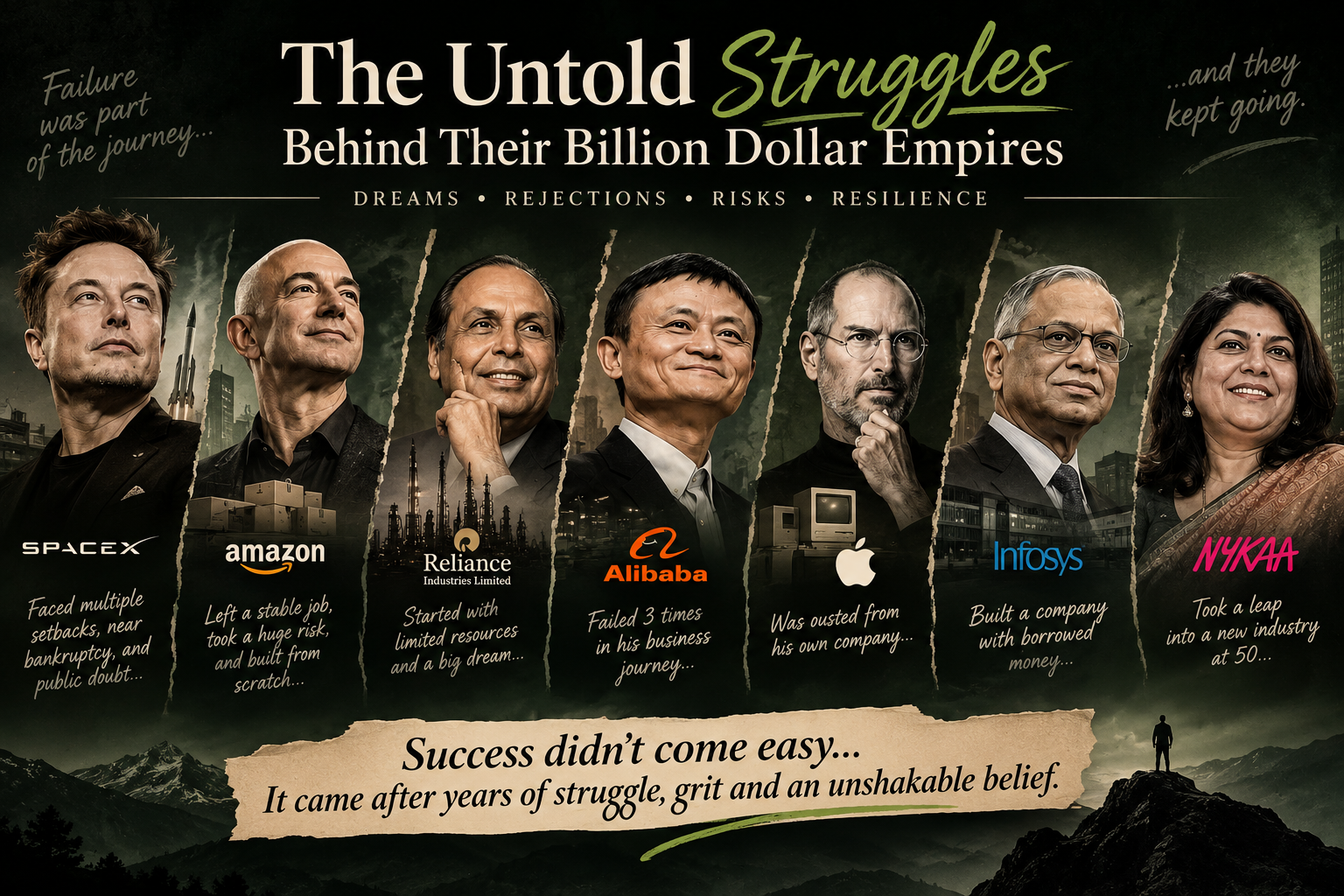

What if the world’s richest entrepreneur companies we admire today were just a few bad decisions away from disappearing?
In 2008, Elon Musk was watching two of his biggest ambitions slip towards disaster. SpaceX had failed three rocket launches in a row, while Tesla was struggling to secure the money it needed to survive. There was no guarantee that either company would make it through the year.
A few years earlier, Jeff Bezos had left a comfortable Wall Street career to sell books on the internet. His idea eventually became Amazon, but not before the company accumulated nearly $3 billion in losses.
And in India, long before Reliance became one of the country’s biggest business groups, Dhirubhai Ambani was working his way through the trading business, trying to build something much bigger than the small operation he had started in Mumbai.
These are not stories that begin with billion-dollar valuations, expensive offices or global recognition. They begin with uncertainty.
What makes them interesting is that none of these entrepreneurs had a completely smooth journey. Some faced financial crises, some experienced professional setbacks, and others discovered that their original business ideas needed to change.
Yet, they kept finding ways to move forward.
Their stories raise an interesting question: Is there a common pattern behind the struggles of the world’s most successful entrepreneurs?
To understand that, let’s go back to the moments when world’s richest entrepreneur’s businesses were still fighting to establish themselves.
1. Elon Musk(World’s Richest Entrepreneur) : The Year When Everything Almost Fell Apart
Imagine having two ambitious businesses, investing much of your personal wealth into them, and then watching both struggle at the same time.
That was Elon Musk’s situation in 2008.
By then, Musk had already made money from his earlier ventures, including PayPal. He decided to put much of his resources and attention into two industries that were particularly difficult to enter: electric vehicles and space exploration.
One company was Tesla. The other was SpaceX.
Tesla wanted to prove that electric cars could be desirable, high-performance vehicles rather than simply an alternative for a small group of environmentally conscious customers.
SpaceX had an even bigger ambition: make space transportation more affordable and eventually take humans beyond Earth.
But turning ambitious ideas into working businesses was proving expensive.
SpaceX’s first three Falcon 1 rocket launches failed. Each failure brought more engineering challenges and financial pressure. Meanwhile, Tesla was dealing with production difficulties and a shortage of funding.
Then the global financial crisis arrived.
Investors became cautious, the automobile industry was under pressure, and raising money for a new electric car company became extremely difficult.
Musk later described 2008 as an exceptionally difficult period. In an interview, he recalled that the fourth Falcon 1 launch was essentially the last one SpaceX could afford at the time.
There was no comfortable backup plan.
On September 28, 2008, the fourth launch succeeded. Falcon 1 reached orbit, making SpaceX the first privately developed liquid-fuel rocket to achieve that milestone.
In December, NASA awarded SpaceX a $1.6 billion cargo resupply contract.
Tesla also managed to secure emergency financing.
Two businesses that had come dangerously close to failure had found a way to continue.
But there is another interesting detail in this story. Musk was not a first-time entrepreneur starting with nothing. His earlier business successes had given him resources to invest in these ventures. Even so, having money and ambition did not protect him from the possibility of losing everything he had invested in the new businesses.
Starting a business is one challenge. Staying committed while the business is consuming money and producing setbacks is another. Sometimes, the difference between continuing and shutting down comes down to whether the founder can solve the next problem before the resources run out.
2. Jeff Bezos: He Left a Secure Job, But What If Nobody Wanted to Buy Online?
In 1994, Jeff Bezos had what many people would consider a dream career.
He was working in the financial industry in New York, earning well and building a professional future.
Then he noticed something that caught his attention: the internet was growing at an extraordinary rate.
While most people were still trying to understand what the internet might become, Bezos was thinking about how it could change shopping.
He began exploring products that could be sold online. Books stood out because there were millions of titles, and an internet-based store could offer customers a selection that a physical shop would struggle to match.
He made a decision that surprised many people around him.
He left his job and moved to Seattle to start an online bookstore.
Amazon began operating in 1995 from a modest garage setup.
But the early business had a problem that is easy to overlook today.
People were not accustomed to shopping online. They had to trust a website with their money, wait for products to arrive and believe that the company would actually deliver what it promised.
Amazon had to build that trust while simultaneously building its technology and delivery infrastructure.
As the company grew, Bezos expanded beyond books. The business invested heavily in warehouses, technology and customer experience.
The costs were enormous.
Then the dot-com bubble burst.
Technology companies that had attracted huge investor interest suddenly found themselves under pressure. Amazon’s stock price fell sharply, and critics began questioning whether the company could survive.
In his statement to the US House Judiciary Committee, Bezos revealed that Amazon had accumulated nearly $3 billion in losses from its founding through the end of 2001. The company did not report a profitable quarter until the fourth quarter of that year.
Imagine being the person responsible for a business that has lost billions while people around you are questioning your decisions.
Bezos continued investing in Amazon’s long-term infrastructure and customer experience. Over time, the company moved beyond books and developed into a much larger technology and commerce business.
Sometimes the market is not ready for the business you are trying to build. But the real challenge is knowing how long to invest, how to manage the financial pressure and how to create something customers genuinely want.
3. Dhirubhai Ambani: Before Reliance Became an Empire, There Was a Small Trading Office
The Reliance story did not begin with a massive factory or a large corporate office.
It began with a much smaller business.
Dhirubhai Ambani travelled to Aden, in present-day Yemen, as a teenager. He worked for A. Besse & Co., gaining exposure to trading and international commerce.
The experience gave him an understanding of how products moved between markets and how commercial relationships worked.
In 1957, he returned to India and started a yarn-trading business in Mumbai.
It was a modest beginning, especially when compared with the industrial empire that Reliance would eventually become.
But Dhirubhai was not interested in remaining a small trader forever.
He understood that the textile market offered opportunities beyond simply buying and selling products.
In 1966, Reliance established its textile manufacturing unit in Naroda, Gujarat. The company also developed the Vimal brand, which became an important part of its growth.
This was a significant change. Instead of depending entirely on trading, the company was now building its own manufacturing capabilities and brand identity.
Another turning point came in 1977.
Reliance went public, and its IPO was reportedly oversubscribed seven times. The listing also helped bring a wider group of ordinary Indian investors into the stock market.
From there, Reliance continued expanding into polyester, petrochemicals and other industrial businesses.
What is particularly interesting about Dhirubhai’s journey is the gradual change in scale. He did not begin by building a giant industrial organisation. He started by understanding one market and then used that experience to enter larger opportunities.
Sometimes the business you start with is not the business you eventually become known for. A small opportunity can open doors to much larger markets if you understand where the next opportunity lies.
4. Steve Jobs: Imagine Being Asked to Leave the Company You Created
Steve Jobs helped build Apple from a small computer venture into one of the most recognised technology companies in the world.
But there was a point when he no longer had a place in the company he had founded.
In 1985, following disagreements with CEO John Sculley and Apple’s leadership, Jobs left the company.
For many people, that might have been the end of their entrepreneurial ambitions.
After all, Apple was not just another employer. It was the business Jobs had helped create.
But Jobs moved on.
He founded NeXT, a company that developed advanced computers for educational and business markets. He also became involved with Pixar, an animation studio that eventually produced films such as Toy Story.
Neither journey was immediately easy.
NeXT struggled to sell its expensive hardware, and its business gradually shifted towards software. Pixar required significant investment before its animation business became commercially successful.
Then came an unexpected development.
In 1996, Apple acquired NeXT. Jobs returned to Apple in 1997.
The technology developed by NeXT became an important foundation for Apple’s operating systems.
Years later, Apple would introduce products that transformed the technology industry, including the iPod, iPhone and iPad.
The interesting part of Jobs’s story is that his time away from Apple was not simply a period of waiting. He continued building businesses, developing products and gaining experience.
Sometimes a setback takes you away from the place where you thought your future would be. It does not necessarily mean your ability to build something valuable has disappeared.
5. Jack Ma: Rejected From Jobs, But Eventually Built One of China’s Biggest Technology Companies
Before Alibaba, Jack Ma was an English teacher in Hangzhou, China.
His early life was not filled with obvious signs of future business success. He experienced academic setbacks and has spoken publicly about repeated job rejections.
One of his most frequently shared stories concerns his unsuccessful application to KFC, where he said he was the only applicant out of 24 who was rejected.
But his business journey took a different direction after he discovered the internet during a visit to the United States in 1995.
He noticed that very little information about Chinese businesses was available online.
He saw an opportunity and started China Pages, an early internet venture.
However, the business faced challenges, and it did not become the major success he had hoped for.
Instead of abandoning the idea of internet-based business, Ma continued exploring the possibilities.
In 1999, he gathered 18 people in his apartment and presented his vision for Alibaba.
The idea was to help businesses connect with buyers through the internet.
But there was a major problem.
Businesses needed to trust an unfamiliar online marketplace. Buyers and sellers needed confidence that transactions would work. And the company needed a business model that could generate sustainable revenue.
The dot-com downturn made things even more difficult. Alibaba had to cut costs and rethink its approach.
The company eventually focused on helping small and medium-sized businesses connect with international buyers.
Over time, it developed into a major e-commerce business.
Rejection does not automatically mean an idea is worthless. But neither does persistence mean repeating the same failed approach. Sometimes the real breakthrough comes when you change how you pursue the opportunity.
6. Narayana Murthy: Building a Global Technology Company With Very Limited Resources
Today, India is known around the world for its IT services industry.
But when Narayana Murthy and six other engineers founded Infosys in 1981, the environment was very different.
Computers were expensive, international communication was difficult, and technology infrastructure was limited.
According to Infosys’s official history, the company began with just US$250 in initial capital.
The founders wanted to build a software services company that could work with international customers.
But convincing customers to trust a relatively unknown Indian company was not easy.
They also had to deal with practical problems: accessing computers, arranging communication facilities, navigating import procedures and developing relationships with overseas clients.
Their early journey required patience.
Instead of trying to become a giant overnight, the founders concentrated on delivering software services and developing their customer relationships.
As India’s technology industry expanded, Infosys was able to grow its international operations.
Today, the company is one of India’s most recognised IT services businesses.
The contrast between its beginnings and its current scale is remarkable.
What this story tells us: Not every business needs enormous funding at the beginning. Sometimes the most valuable starting point is a skill that solves a real business problem, supported by a team that can deliver consistently.
7. Falguni Nayar: Starting a Business at 49 When Most People Would Prefer Stability
There is another kind of entrepreneurial risk that doesn’t receive enough attention.
It is the risk of starting again when you already have a successful career.
Falguni Nayar had spent nearly two decades in investment banking before deciding to enter the beauty and personal care industry.
In 2012, at the age of 49, she founded Nykaa.
She wasn’t entering a completely new market. Beauty products already had established retailers, brands and distribution channels.
The opportunity she saw was in how customers discovered and purchased these products.
At the time, buying beauty products online in India was still developing. Customers often preferred physical stores because they could examine products and get recommendations.
Nykaa had to build customer confidence while developing its online platform.
The company gradually expanded its product selection, worked with established brands, introduced its own products and eventually opened physical stores.
In 2021, Nykaa went public.
Nayar’s journey stands out because it challenges a common assumption about entrepreneurship: that the best time to start a business is when you are young.
Her story suggests that experience in one industry can sometimes provide the confidence and understanding needed to build something in another.
Starting a business is not necessarily about age. It is about recognising an opportunity and being willing to take a calculated risk.
The Interesting Part: What Do All These Entrepreneurs Have in Common?
After looking at these journeys, one thing becomes clear.
There is no single formula that explains how someone becomes a successful entrepreneur.
Dhirubhai Ambani started with trading. Bezos started with books. Jack Ma experimented with early internet businesses. Narayana Murthy built a software services company. Musk invested in technically challenging industries. Steve Jobs experienced a major professional setback before returning to Apple.
Their financial backgrounds, opportunities and access to resources were not the same either.
However, there are some recurring experiences worth paying attention to.
Their first businesses were much smaller than their ambitions
Amazon began as an online bookstore. Reliance began with yarn trading. Infosys started with a small group of engineers. Alibaba began with a founding team working from an apartment.
They did not need to build their entire empire on day one.
They started with something specific and expanded over time.
They had to earn people’s trust
A business idea may look attractive to its founder, but customers do not automatically agree.
Amazon had to convince people to buy products online. Alibaba had to make online business transactions more trustworthy. SpaceX had to demonstrate that its technology could work.
Trust was not something these companies could demand. They had to earn it.
Money became a problem even when the ideas were promising
This is one of the most important parts of entrepreneurial life.
A company can have a promising product and still struggle because it doesn’t have enough money to pay employees, manage production, develop technology or reach customers.
SpaceX and Tesla faced severe financial pressure in 2008. Amazon accumulated substantial losses while building its business. Infosys had to grow in an environment where technology infrastructure was limited.
The lesson is simple: a good idea needs a financially sustainable business behind it.
Their original plans didn’t always work
Jobs moved beyond his first experience at Apple. Jack Ma moved on from China Pages. Bezos expanded Amazon beyond books. Reliance moved from trading into manufacturing and petrochemicals.
Their journeys involved changes in strategy, not just persistence.
They eventually learned to build organisations, not just businesses
A small business can depend heavily on its founder.
A large business needs people, systems, technology, distribution and leadership.
This transition is often overlooked when people study billionaire success stories.
The challenge does not end when a company starts making money. In many ways, that is when a completely new set of challenges begins.
The Common Trajectory Behind Billion-Dollar Businesses
If we connect these stories, a recurring pattern emerges.
It is not a guaranteed formula for success, but it offers an interesting way to understand how businesses grow.
First comes the idea. Someone notices an opportunity that others may have overlooked.
Then comes the difficult beginning. The founder has to turn that idea into a product or service with limited resources.
Next comes resistance. Customers may not understand the product, investors may hesitate, and established competitors may have a significant advantage.
Then comes the real test: survival. Financial pressure, operational problems and failed decisions can threaten the future of the company.
After that comes adaptation. The founder has to reconsider the business model, understand the mistakes and find a more practical way forward.
Finally comes the challenge of scaling. What worked for a small team may not work for thousands of employees, millions of customers or multiple markets.
And this is where the stories become even more interesting.
Success doesn’t mean the struggles are over. It simply means the business has reached a different stage, with a different set of problems to solve.
Final Thoughts: Perhaps We Should Study Their Failures More Than Their Fortunes
When people talk about Elon Musk, Jeff Bezos, Dhirubhai Ambani or Steve Jobs, the conversation usually revolves around their wealth, companies and achievements.
But there is another side to these stories.
The failed rocket launches. The money that almost ran out. The company that questioned its founder’s leadership. The early business ideas that didn’t work. The years spent trying to convince customers that a new way of doing things was worth trusting.
These are the moments that make their entrepreneurial journeys worth studying.
And perhaps the biggest lesson is not that every person who faces difficulties will become a billionaire. That would be an unrealistic conclusion.
It is that building something meaningful often involves dealing with uncertainty for much longer than expected.
Some entrepreneurs find the right opportunity early. Others have to change direction several times. Some have access to capital and networks, while others begin with very limited resources.
Their journeys are different, but they all offer one important reminder.
The world usually sees the company after it becomes successful. Very few people see the years when its founder is still trying to figure out whether the business will survive.
And that is where the real story begins.
Leave a Reply